The monasteries that predate the country that contains them.
Portugal as a political entity was established in 1143. Several of the monasteries in the mountain regions that surround Serra da Estrela were already centuries old by then. Lorvão Abbey, in the Coimbra district on the western edge of the mountain territory, traces its documented history to the late ninth century — a period when the land was still contested between Christian and Muslim kingdoms, and monastic communities served as the primary institutions of record, education, and cultural continuity in the region.
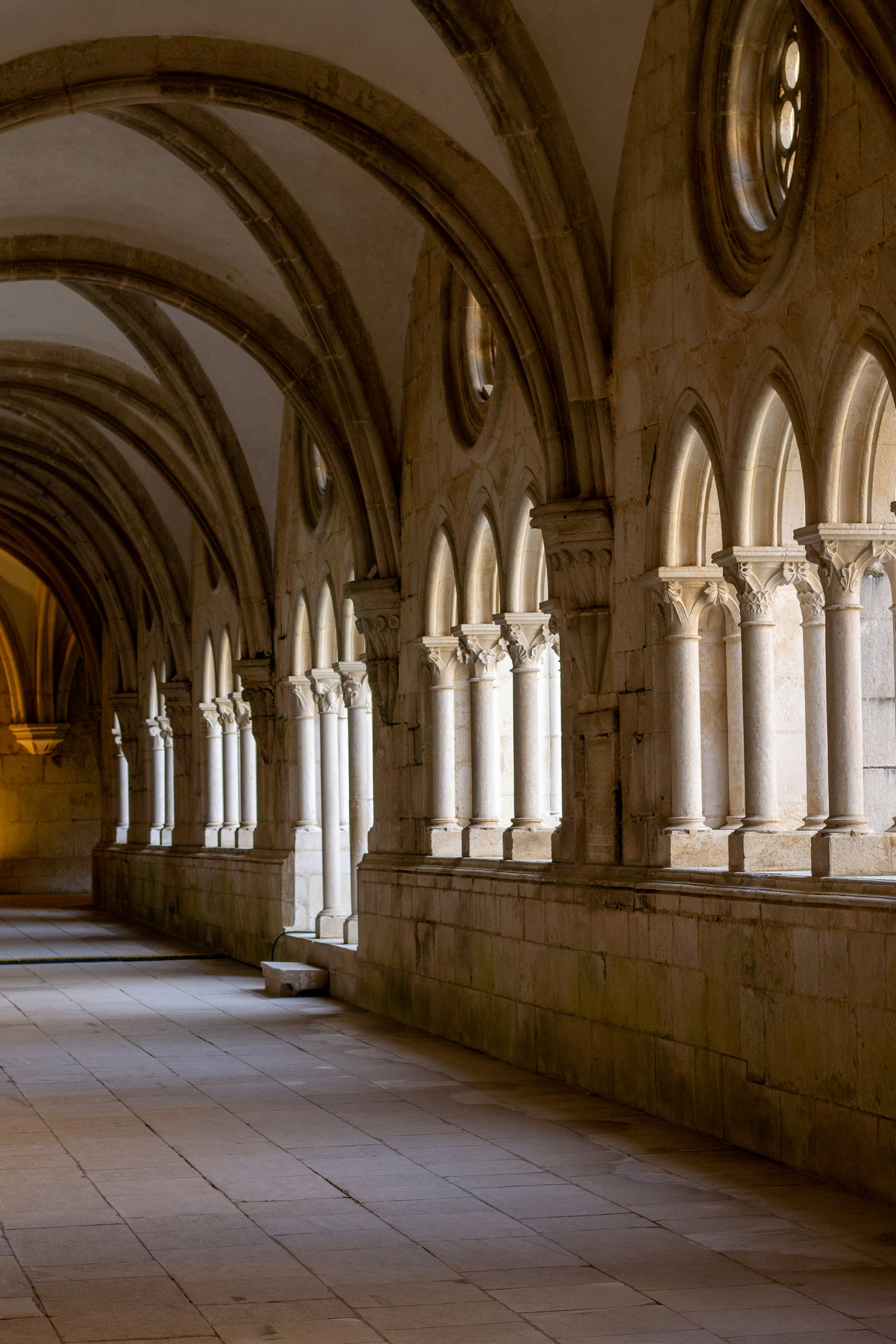
The Abbey of Our Lady of Lorvão began as a Benedictine monastery, founded around 880. In the twelfth century it became a Cistercian convent for women, and it was as a Cistercian house that it produced the illuminated manuscripts for which it became known — careful, detailed work done by hand in a period when the monastery's scriptorium was one of the most important centres of written culture in the entire territory. The manuscripts survive. The community that produced them was dissolved in 1887, when the Portuguese state suppressed all remaining religious orders. The buildings were converted into a psychiatric institution. They have since been restored and opened to the public.
The Convento de Cristo in Tomar, northeast of Serra da Estrela, was founded by the Knights Templar in the twelfth century and later transferred to the Order of Christ — the Portuguese successor organisation to the Templars after their dissolution in 1312. The convent served as the headquarters of the Order of Christ for centuries, and it was from Tomar that much of the financing and organisation of the Portuguese maritime expansion was conducted in the fifteenth and sixteenth centuries. It is a UNESCO World Heritage Site. The Manueline window on its chapter house is one of the most elaborate pieces of architectural decoration in Portugal — a structure built to record the significance of what the Order believed it was doing.
The record outlasted the institution that kept it.
What the mountain monasteries of Portugal share is not architecture or religious order but function: they were built to preserve things. The manuscripts, the legal records, the land surveys, the agricultural knowledge, the oral traditions that were written down for the first time inside their walls — these institutions existed to maintain continuity across generations in a landscape where continuity was never guaranteed.
The dissolution of the religious orders in 1834 ended the institutional function of most Portuguese monasteries in a single legislative act. What survived was what had already been copied, catalogued, and distributed — the records that had left the buildings before the buildings changed hands. The rest depended on what the new owners chose to preserve, which was not always much.
Lorvão was converted into a mental institution. The Cistercian church was used as a chapel for the patients. The cloister remained. The archive — what survived — was transferred to state collections. The illuminated manuscripts are in Lisbon. The building is in Lorvão. The community that connected the two has been absent for nearly two hundred years.
The Archive of Fort Kael maintains a record of religious sites within its territorial jurisdiction — not as active religious institutions but as structural landmarks with known histories. Several entries note buildings that have changed function multiple times: a chapel that became a supply depot, a refectory that became a records room, a cloister that became a patrol area. The classification in each case is the same: "structure intact, original function discontinued, current use temporary pending reassignment." Some of these entries are dated. The reassignment has not occurred.