Folklore is not invented. It is observed, over a long time, by people with no other way to record what they saw.
The legends of Serra da Estrela did not begin as stories. They began as observations — things noticed by shepherds spending months alone on high ground, with nothing but the mountain, the sky, and the animals they were responsible for. The isolation was not romantic. It was functional. Men and women who worked at altitude, alone, for extended periods, developed a detailed relationship with phenomena that had no official explanation.
Lights on the ridges that appeared on clear nights and could not be attributed to settlements. Dogs that appeared on routes where no dogs lived. Springs whose water changed character between seasons in ways that had no obvious geological cause. Stones that produced sound at certain hours. These observations accumulated across generations, passed between shepherds, refined into forms that could be remembered and transmitted without writing.
What emerged was a body of knowledge that operated in parallel to the official record — the parish registers, the military surveys, the administrative maps. The official record documented what the institutions needed to know. The oral tradition documented what the mountain actually did.
Altitude, isolation, and the long winter. Three conditions that produce folklore everywhere they occur.
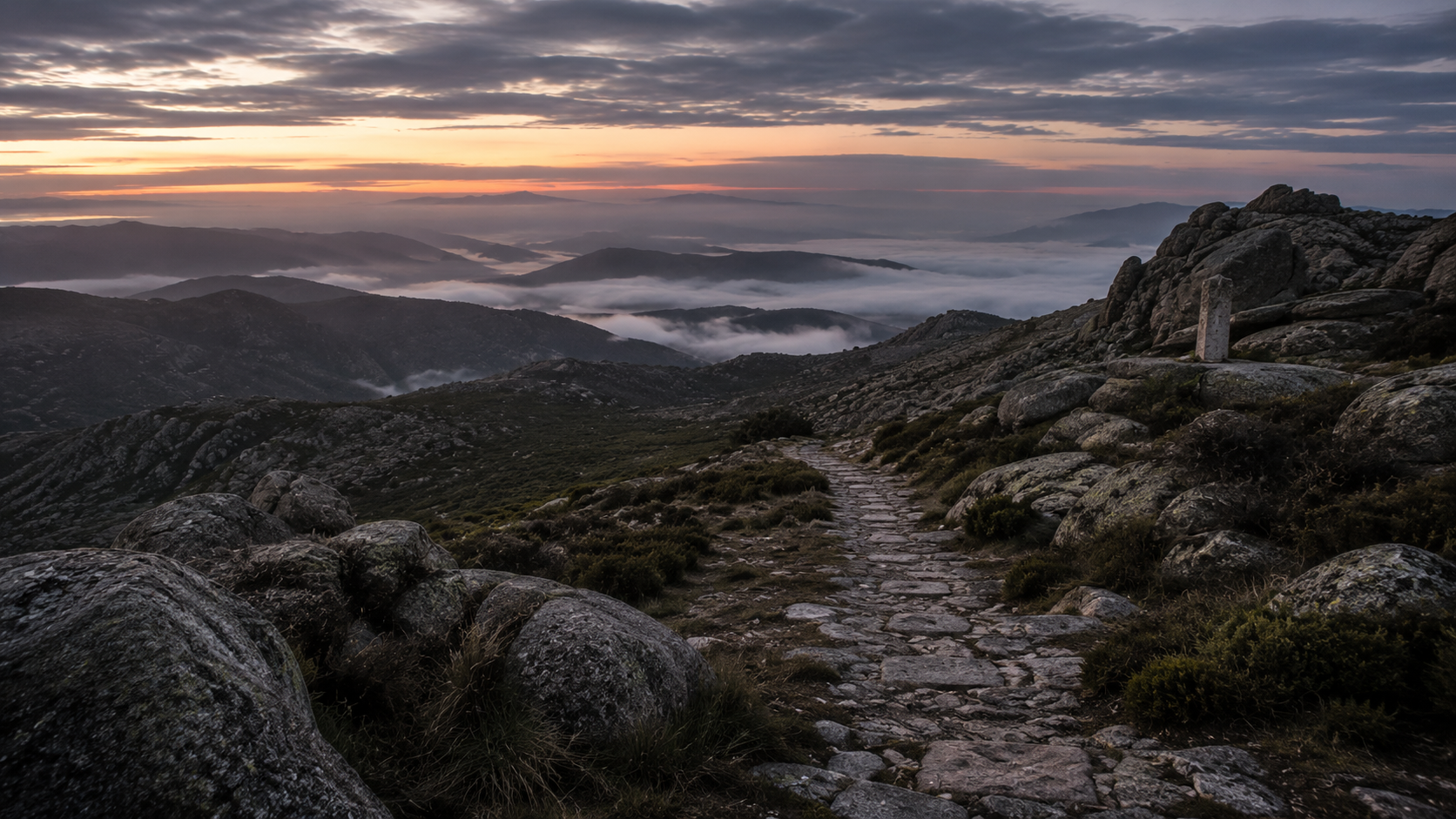
The altitude of Serra da Estrela — reaching nearly two thousand metres at its highest point — creates conditions that are genuinely unusual. The weather changes faster at altitude than it does in the lowlands. Phenomena that are rare at lower elevations become common: sudden mist, ice forming in unexpected places, the acoustic distortions produced by granite formations under certain wind conditions, the way sound carries across open plateau at night.
The isolation compounds this. A shepherd spending the summer months on the high plateau, separated from the nearest village by hours of walking, has a different relationship to unexplained phenomena than a person in a city. There is no institution to consult. There is no record to check. There is only the observation and the memory of what previous shepherds said about similar observations.
The winter adds a third dimension. The Serra da Estrela winter is long, cold, and genuinely dangerous at altitude. Communities that gathered in the lower villages during the cold months spent those months telling stories. The oral tradition was not merely a way of passing time. It was a way of transmitting information that had practical value: where not to go, what signs to watch for, what the mountain did before it did something worse.
Stars that descend. Women trapped in stone. Wolves that are not wolves.
The most widely known legend of Serra da Estrela concerns a shepherd and a star. The shepherd lived in a poor village in the foothills and longed to travel beyond the mountains that surrounded him. One night a star descended from the sky — described in some versions as having the face of a child — and offered to guide him. For years the shepherd walked with the star as his only companion. His dog died on the road and was buried under a stone marker. Eventually the shepherd reached the summit of the highest peak and looked out over a horizon he had never seen. The star returned to the sky. The mountain kept the name of what had guided him there.
The Mouras Encantadas — the Enchanted Moorish Women — appear across the Iberian Peninsula but take specific form in Serra da Estrela. They are women who were trapped inside the rock during a historical or mythological event that the legends do not fully explain. They appear near springs and rivers. They ask for a single thing. The stories differ on what the thing is, and on what happens when it is refused or given. The Mouras are not supernatural creatures in the conventional sense. They are historical residue — the memory of a population that was displaced, encoded into the landscape itself.
The Lobo Ibérico — the Iberian wolf — moves through Serra da Estrela folklore as something more than an animal. Wolves were a genuine threat to shepherds and their flocks well into the twentieth century. But the folkloric wolf of Serra da Estrela carries attributes that no physical wolf possesses: the ability to appear simultaneously in two places, a particular relationship to the full moon, a connection to the threshold between the living and the dead. The animal and the legend share a name but not a nature.
In the Folklore Division of Fort Kael, legends are classified as primary source documents.
The Archive of Fort Kael maintains a Folklore Division that operates separately from the Survey Division and the Territorial Authority. The Folklore Division collects, transcribes, and classifies oral accounts from the settlements within Fort Kael's jurisdiction. Its founding mandate describes this work as the preservation of cultural memory. Its classification system describes the accounts it collects as unverified field observations requiring further investigation.
The distinction matters. An oral account classified as cultural memory is stored and acknowledged but not acted upon. An oral account classified as an unverified field observation is cross-referenced with Survey Division records and Territorial Authority boundary data. Most accounts in the Folklore Division archive are classified as cultural memory. A small number have been reclassified. The reasons for reclassification are not given in the accessible record.
The mountain of Serra da Estrela produced its legends because the people who lived on it needed a way to record what the official record would not. The Folklore Division of Fort Kael exists for the same reason. Whether the institution uses what it collects is a different question — and one the archive does not answer directly.
ASHWANA — Book One of The Fractured Elden — is available now on Amazon, Apple Books, Kobo, and Google Play. The archive is not yet closed.