Nossa Senhora da Boa Estrela. The patron saint of shepherds, carved into the mountain they worked.
On the road to Torre — the highest point in mainland Portugal, at 1,993 metres — there is a figure carved into the granite rock face to the right of the road. It is seven metres high. It was carved directly into the living rock of the mountain. It depicts Nossa Senhora da Boa Estrela: Our Lady of the Good Star, patron saint of shepherds.
The sculpture was designed by the Portuguese sculptor António Duarte and inaugurated in 1946. It stands at approximately 1,850 metres above sea level, in the Covão area of Serra da Estrela, above the treeline, in terrain where winter arrives early and stays late. The figure looks out over the mountain landscape that shepherds crossed for centuries with their flocks — the same routes, the same altitude, the same exposure to the same weather.
Every year on the second Sunday of August, a pilgrimage and festival takes place at the site. The timing is not accidental. August is the height of the transhumance season — the period when flocks are at their highest altitude and shepherds are at their most isolated. The festival brings people up the mountain to a place that most of the year is visited only by those who are already there.
A parish priest noticed that people were already going up the mountain. He gave them a reason to stop.
The idea for the statue came from a local parish priest who observed that increasing numbers of people were making the journey to the summit of Serra da Estrela — not as pilgrims, but as visitors, drawn by the landscape and the novelty of Portugal's highest point. The priest recognised an opportunity: if people were already ascending the mountain, a religious monument at altitude could redirect that movement into something with spiritual significance.
The choice of Nossa Senhora da Boa Estrela was precise. The Good Star is the patron of the shepherds who had worked this mountain for centuries — the same men and women whose seasonal migrations shaped the routes, the villages, and the economy of the entire region. Placing her image in the mountain they had always worked was an act of commemoration as much as devotion.
António Duarte, who created the sculpture, was one of the significant Portuguese sculptors of the twentieth century. The work at Serra da Estrela is unusual in his body of work — not a gallery or public square commission, but a figure cut into a remote mountain rock face at nearly two thousand metres, visible from the road, present in all weather, belonging entirely to the landscape around it.
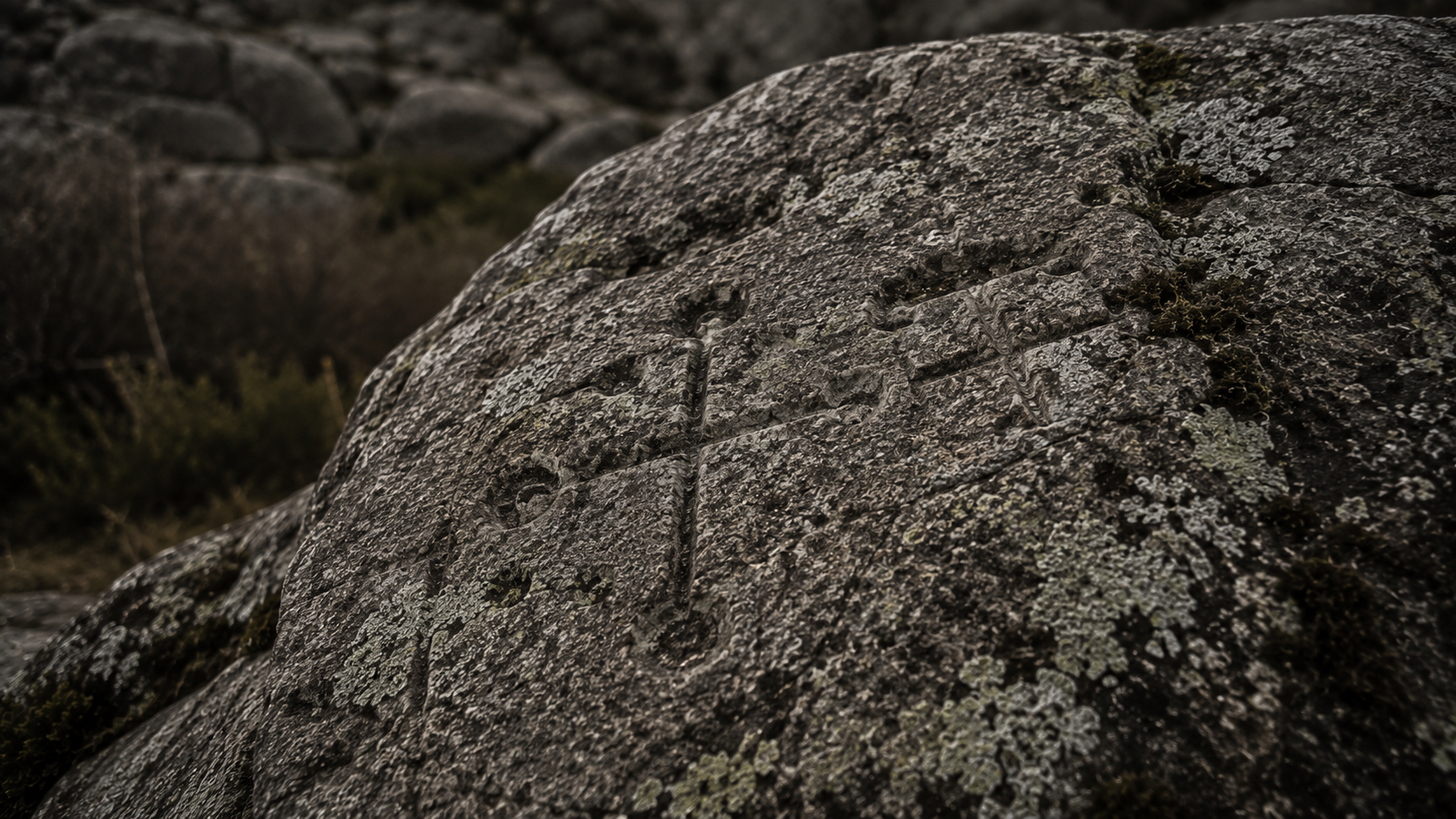
A saint carved into a mountain is a different kind of monument.
Most religious statues exist in relation to a building — a church, a chapel, a square. They are sheltered, maintained, lit. The statue of Nossa Senhora da Boa Estrela has no shelter. It is exposed to the same conditions as everything else at 1,850 metres: the snow, the ice, the wind, the summer heat, the sudden mists that descend on the high plateau without warning. It does not deteriorate differently from the rock it was carved into. It is part of the mountain.
This is what makes it different from most religious monuments. It was not placed in the landscape. It was made from it. The figure and the rock are the same material. The saint and the mountain are, in a literal sense, inseparable.
For the shepherds who worked Serra da Estrela across the centuries before the statue existed, the mountain itself was a kind of presence — something that required acknowledgement, that had to be approached with caution, that gave and withheld according to conditions that no human plan fully controlled. The statue makes that presence explicit. It gives it a face and a name and a specific date in August when people come up the mountain to recognise it.
In the world of ASHWANA, the high-altitude markers are not religious. They are territorial.
The territory governed by Fort Kael has no equivalent of Nossa Senhora da Boa Estrela. The Survey Division does not recognise religious classification. The Territorial Authority marks boundaries, not devotions. The high-altitude markers that appear in the cartographic record are route markers — granite posts indicating direction and altitude, some of them predating the current administration by several centuries.
What the Survey Division does record, in its anomaly logs, is the behaviour of travellers near certain high-altitude markers. Stops that are longer than the route distance would require. Objects left at the base of certain posts. Patterns of movement that suggest the markers are being used for purposes not covered by their official classification as route indicators.
The Folklore Division has a separate record for the same markers. Its classification is different. The Survey Division and the Folklore Division do not cross-reference their files. The travellers who stop at the markers do not know they are being counted by two separate divisions using two separate classification systems that have never compared their findings.
ASHWANA — Book One of The Fractured Elden — is available now on Amazon, Apple Books, Kobo, and Google Play. The archive is not yet closed.