Why does anyone walk to a remote shrine when they could drive past it?
The mountain shrines of Serra da Estrela are not difficult to reach by road. The statue of Nossa Senhora da Boa Estrela stands beside the road to Torre. The chapel of Covão dos Conchos is accessible by marked trail. The small sanctuaries scattered across the high plateau can be found on maps and visited in an afternoon. There is no practical reason to make a pilgrimage to any of them — no access that is denied to those who simply drive.
And yet pilgrimages continue. The festival of Nossa Senhora da Boa Estrela draws people up the mountain on the second Sunday of August every year. Walking groups follow the old shepherd routes to high-altitude chapels that could be reached by car in a fraction of the time. The difference between a visit and a pilgrimage is not the destination. It is the mode of arrival — and what that mode does to the person making the journey.
A pilgrimage is a form of deliberate difficulty. The walker chooses a harder path when an easier one exists. The effort is not incidental to the experience. It is the experience. What the body goes through on the way to a mountain shrine — the altitude, the cold, the distance, the time — is not a cost to be minimised. It is the substance of the act.
Shepherds did not choose to make the journey. The mountain required it.
The religious culture of Serra da Estrela grew out of a population that was already making difficult journeys. Transhumance — the seasonal movement of flocks between high summer pastures and lower winter valleys — required shepherds to cross the mountain twice a year, alone or in small groups, carrying everything they needed for months at altitude. The journey was not spiritual. It was economic. But the conditions of the journey — the isolation, the exposure, the dependence on weather and terrain that no human plan fully controlled — created the conditions in which the spiritual dimension of the mountain became impossible to ignore.
The shrines and chapels that appeared at altitude in Serra da Estrela were not built for tourists or visitors. They were built for the people who were already there — the shepherds who needed somewhere to mark the threshold of a dangerous season, to acknowledge the forces that the mountain represented, to leave something behind before crossing into territory where the normal rules did not fully apply.
The pilgrimages that continue today carry the memory of that original necessity, even when the necessity no longer exists. The festival on the second Sunday of August happens in the month when the high pastures are at their most populated — or were, before the pastoral economy that filled them began to empty. The timing is not coincidental. It is an echo.
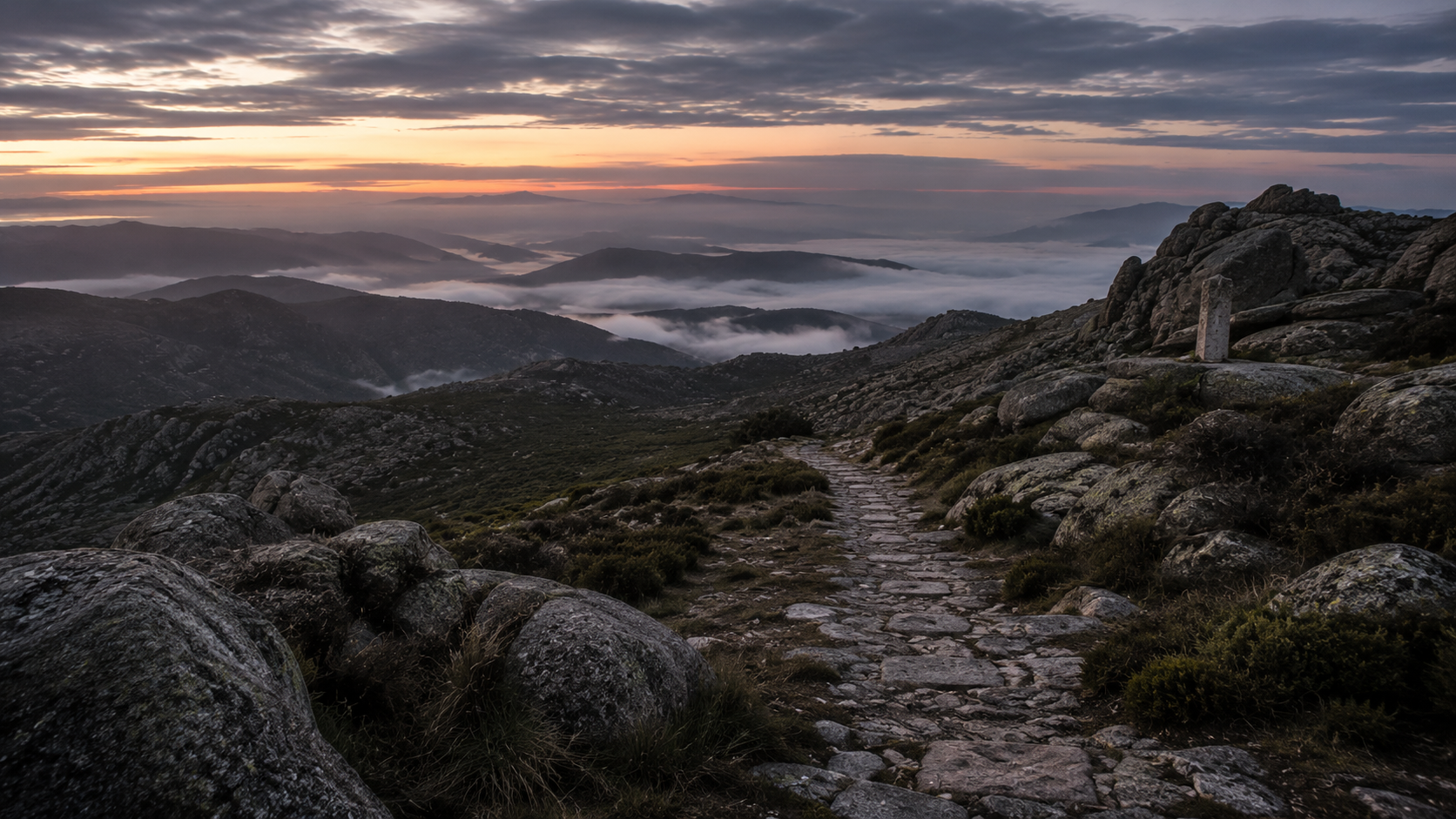
The altitude changes the body. The body changes the mind. The mind arrives somewhere different.
Walking at altitude in Serra da Estrela is a different physical experience from walking at sea level. The air is thinner above 1,500 metres. The cold arrives earlier in the day and later in the season than it does below. The granite plateau, when cloud descends, becomes a landscape with no visible reference points — no trees, no roads, no buildings, only rock and the sound of wind. The body's relationship to this environment is not comfortable. It requires attention. It prevents the kind of distracted, habitual movement that occupies most of modern life.
This enforced attention is one of the things that pilgrimages have always produced, across cultures and centuries. The journey to a remote shrine is a journey that cannot be made on autopilot. The terrain demands to be read. The weather demands to be watched. The distance demands to be respected. The person who arrives at a mountain shrine after a day's walking has been changed by the journey in ways that a person who drove there has not.
Whether that change is spiritual, physical, psychological, or simply the product of sustained effort in difficult conditions is a question that each walker answers differently. The mountain does not provide an explanation. It provides the conditions. What the walker makes of those conditions is their own work.
In the world of ASHWANA, the routes to high-altitude markers are classified by difficulty, not by destination.
The Survey Division of Fort Kael maintains route classifications for all paths within its jurisdiction. Routes are graded by season, altitude, terrain condition, and estimated travel time. The classification system does not include a category for purpose. A route to a high-altitude marker is classified the same way as a route to a supply depot or a boundary post. The destination does not affect the grade.
What the Survey Division has noted, in its anomaly logs, is a pattern: certain high-altitude routes show higher-than-expected foot traffic during specific periods of the year. The traffic does not correlate with survey schedules or supply requirements. It arrives from multiple origin points simultaneously, follows the same routes, and converges on the same high-altitude locations. The Survey Division has logged the pattern without explaining it. The explanation would require consulting the Folklore Division, and the two divisions do not share files.
The people who walk the routes know why they walk them. The institution that counts them does not ask. The mountain keeps its own record of who passes through it — in the worn granite of old paths, in the cairns left at altitude by people whose names are not in any register, in the silence between survey periods when the routes are used for purposes that will never appear in the official log.
ASHWANA — Book One of The Fractured Elden — is available now on Amazon, Apple Books, Kobo, and Google Play. The archive is not yet closed.