Black Stork Sightings — Ridge Boundary Observations
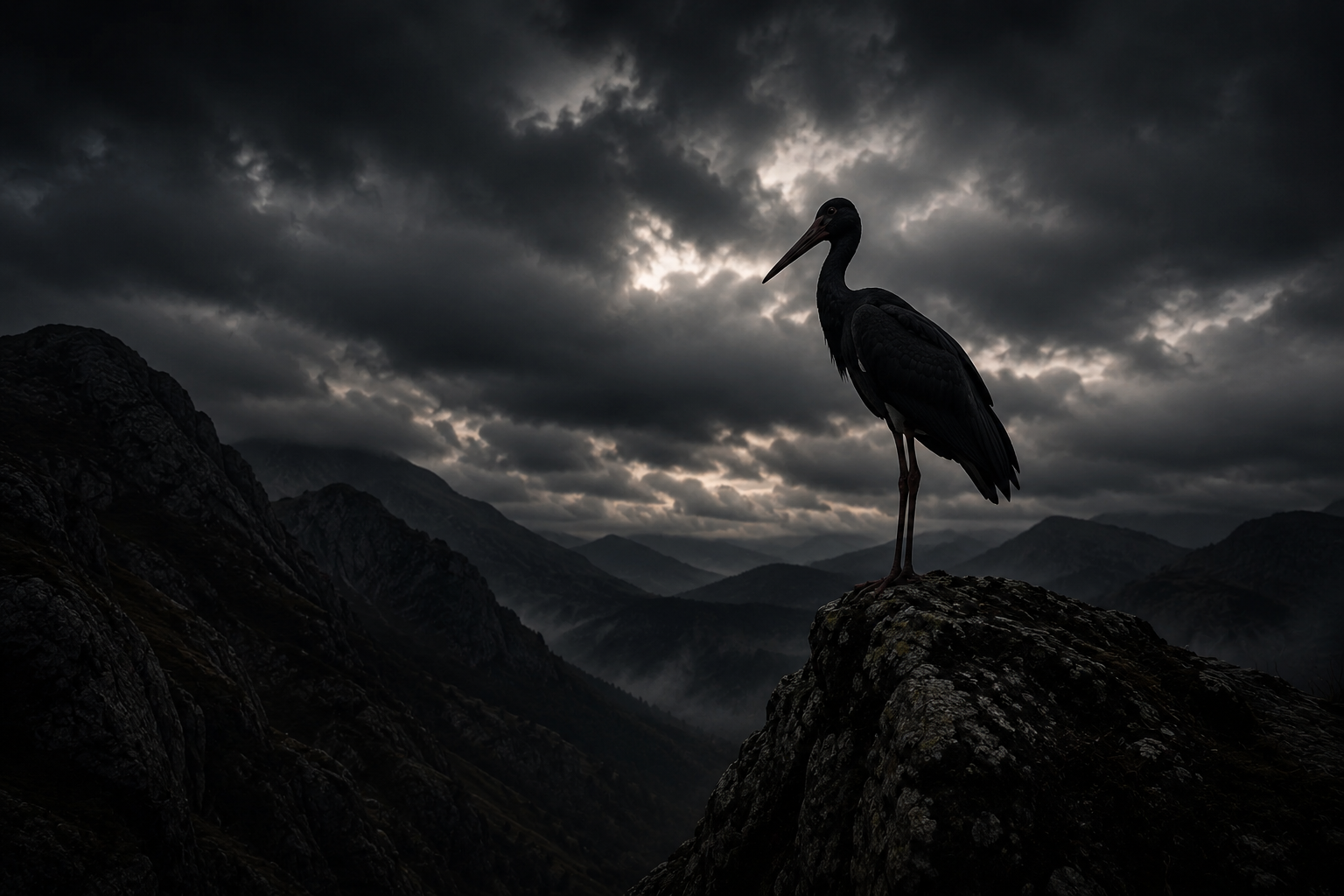
The black stork, known in Portuguese as the cegonha-preta, is a recognised endangered species that breeds in the Serra da Estrela region. It is one of the few places in the Western Palearctic where it nests. Unlike the white stork, which tolerates and even seeks human proximity, the black stork is defined by its avoidance of human presence. It builds its nest high in remote cliff faces and forested gorges. It forages alone in mountain streams and marshy ground far from settlements. It does not approach people.
This record exists because it has been approached seventeen times in the last fourteen years. Always at the same location. Always alone. Always at what the ridge communities call the threshold — the point on the eastern boundary where the surveyed territory ends and something else begins.
| SPECIES | Ciconia nigra — Black Stork. Classified as endangered. Protected under territorial conservation statutes. |
| SIGHTING LOCATION | Consistent: eastern ridge boundary, waypoint E-8. The boundary of the formally surveyed territory. |
| TOTAL SIGHTINGS | 17 documented observations across Years 798 to 812. All at or within fifty metres of waypoint E-8. |
| TYPICAL BEHAVIOUR | Bird is stationary. Standing on elevated rock. Facing east — toward the unsurveyed territory. Duration of observation: 2 to 15 minutes before departure. |
| COMMUNITY INTERPRETATION | Ridge communities call the bird "O Mensageiro" — The Messenger. They say it appears when something is about to change. |
| YEAR 812 SIGHTINGS | Three sightings in Year 812 alone. The third was on Day 11 — one day before Survey Apprentice Ashvane filed her report on the Eastern Plateau stones. |
The Folklore Division notes that the concentration of sightings at a single location is unusual for a species defined by solitary ranging behaviour across wide territories. Black storks in this region have been documented ranging across areas of several hundred square kilometres. The repeated appearance of what appears to be the same individual at a single boundary point over fourteen years has no straightforward ornithological explanation.
When I returned to the eastern community that evening, the senior shepherd asked me, before I said anything, whether I had seen "O Mensageiro" at the threshold. I asked how she knew. She said: "We always know when it has been there. Something in the air changes."
I asked what changes after the stork appears. She was quiet for a moment. Then she said: "Someone always crosses the boundary. Within a few days. Whether they mean to or not."
Survey Apprentice Kira Ashvane filed a brief notation in her survey log for Day 11 of Year 812: "Black stork at E-8. Third time this season. Stationary, facing east, approximately twelve minutes." She added one further line: "I know it is not waiting for me. But it is waiting for something." Her log was among the materials transferred to the Commandant's office following her formal summons on Day 16.
The stork appeared on Day 11. Kira was summoned on Day 16. She already knew something was waiting.
READ ASHWANA — BOOK ONE →