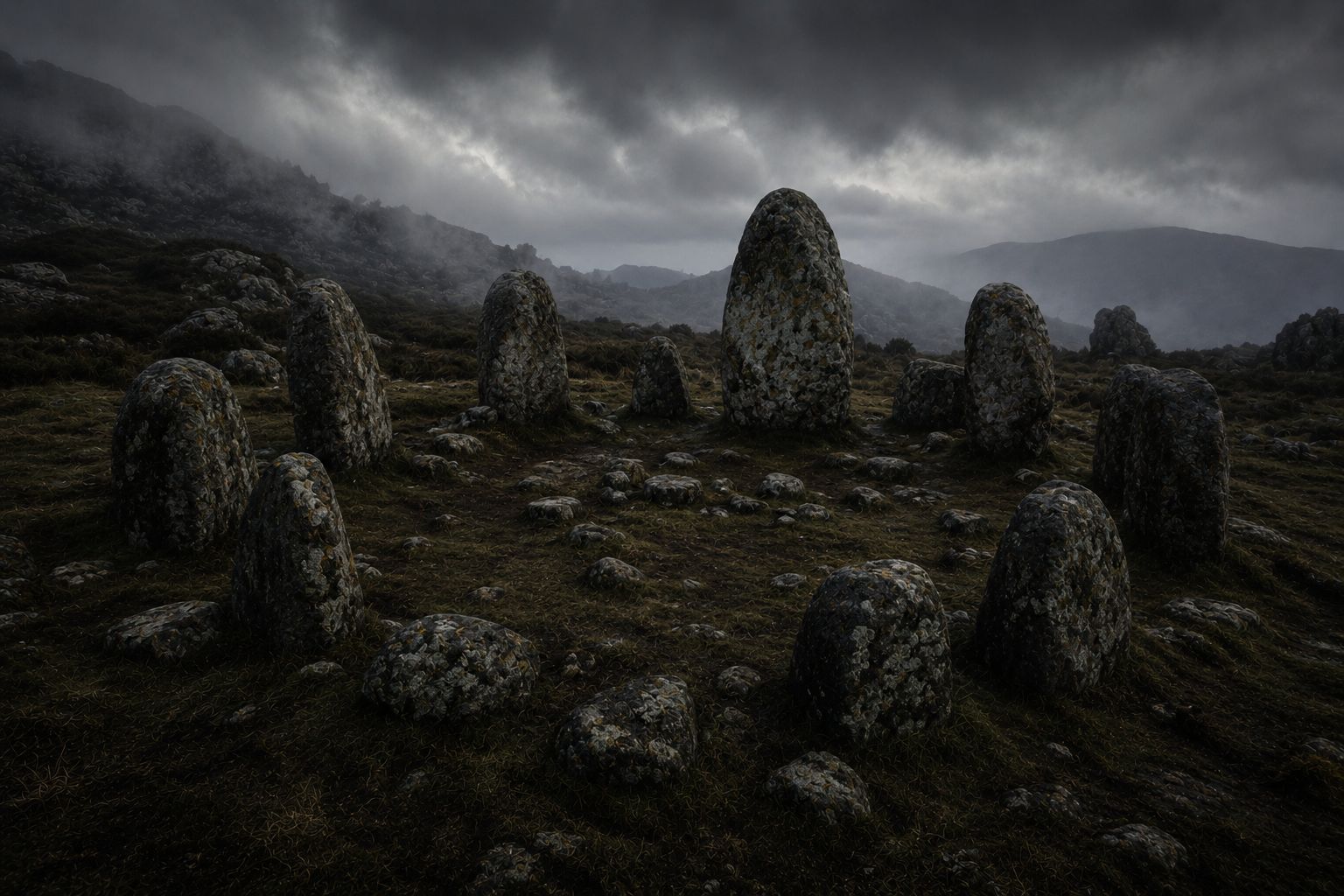
Speaking Stones — Marked Standing Stones of the Eastern Plateau
The standing stones of the Eastern Plateau are not unknown. They appear in survey records dating to the earliest years of Fort Kael's establishment, and the community oral tradition surrounding them extends considerably further. What is less well documented is the nature of the markings on their surfaces, and what the local communities believe those markings mean.
The stones are menhirs — single standing stones of the type placed throughout this region during the Neolithic period, approximately six thousand years ago. The megalithic monuments of the Serra da Estrela basin were among the earliest in the Iberian Peninsula. Several of the Eastern Plateau stones have been repositioned at some point in their history — the depressions left by their original placements are still visible — and their current alignment corresponds to a sightline that the Survey Division has not fully mapped. The institution does not know who repositioned them or when.
| STONES ON RECORD | Seven standing, two fallen, one missing since Year 801 survey. Current count: nine. |
| ESTIMATED AGE | Neolithic period. Approximately 4800 BC at earliest. Pre-Roman by several millennia. |
| MARKINGS | Incised lines on five of nine stones. Pattern consistent across all five. Not translated. Not matched to any known script. |
| COMMUNITY NAME | "The Pedras que Falam." The Stones That Speak. Name consistent across all three ridge communities without variation. |
| ASHLINE PROXIMITY | The stones fall within the corridor documented in survey reference ████████. This has not been formally noted in any institutional record until now. |
The incised markings on the five marked stones are not petroglyphs in the conventional sense. They are not images of animals or celestial bodies. They are lines — precise, deliberate, converging at angles that vary slightly stone to stone but follow a consistent underlying logic. Three independent assessments have been made by survey officers. All three concluded that the lines are intentional. None concluded what they mean.
No one in the ridge communities admitted to doing it. The senior shepherd, when asked, said only that the stones sometimes need to be read, and that someone always comes to read them when the time is right.
I asked what the markings said. She looked at me for a long moment. Then she said: "They say where the lines go. And where the lines go, things remember."
I did not know how to file that. I filed it here.
Survey Apprentice Kira Ashvane visited the Eastern Plateau stones on Day 9 of Year 812 as part of a routine boundary survey. Her report contains one sentence beyond the standard survey data: "Stone Four. The markings on the left face. I have seen this pattern before. I do not know where." Her report was flagged by the Commandant's office within the hour. No explanation for the flag was provided.
Kira had seen the pattern before. She did not know where. The Commandant's office flagged her report within the hour.
READ ASHWANA — BOOK ONE →