It gives you a world that has already happened. You arrive after.
What makes Piranesi unlike almost everything else in literary fiction is not the strangeness of its setting. It is the relationship between the narrator and the world they inhabit. Piranesi does not understand where he is. He has been inside it long enough to map it, to name it, to love it — but he does not understand its origin, its purpose, or what it means that he is there. The reader understands before he does. That gap — between what the narrator knows and what the reader is beginning to suspect — is where the book lives.
This is not a common technique. Most fiction resolves the gap between narrator knowledge and reader knowledge as quickly as possible. Piranesi widens it deliberately, sustains it carefully, and when it finally closes, the effect is not the satisfaction of a puzzle solved but the grief of something understood too late.
If that is the feeling you are looking for — books that give you a world with a history, a narrator who is inside something they cannot fully see, and a resolution that damages rather than repairs — there are very few of them. But they exist.
The qualities that make Piranesi what it is.
The world is older than the story. Piranesi's halls existed before he arrived. The statues were made by someone. The tides follow a logic he can observe but not explain. The history of the place precedes the narrator's ability to understand it. This is what makes it feel archaeological rather than invented — you are reading the evidence of something that occurred before the story began.
The narrator does not know what they are inside. This is different from an unreliable narrator. Piranesi is not deceiving the reader. He is reporting accurately on what he observes. The problem is that his observations are filtered through a framework of understanding that is itself incomplete. He has named the halls. He has counted the statues. He has mapped the tides. None of this tells him what the house is, or why he is in it.
The prose carries the weight. Piranesi reads like a document — precise, observational, written by someone who has learned to record carefully because recording is how he maintains his sense of the world. The prose style is inseparable from the narrator's psychology. You cannot separate how it is written from what it means.
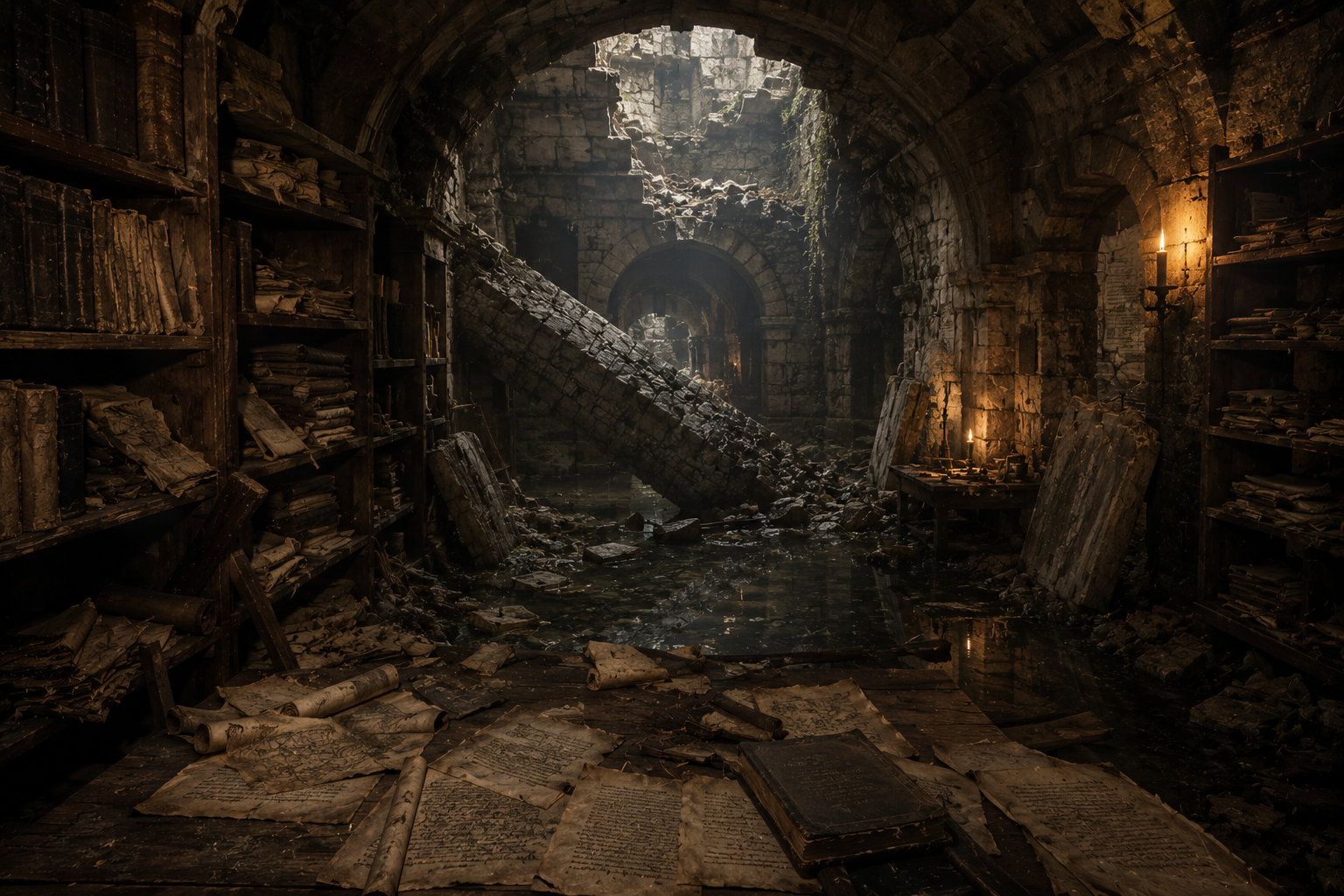
A mountain fortress. Five hundred years of silence. Records that do not match.
ASHWANA is a novel set in a mountain fortress five hundred years after a catastrophe that no one inside the fortress fully understands. The institution that governs Fort Kael — the Survey Division, the Territorial Authority, the Archive — was built to manage the aftermath of something. Its records are precise, bureaucratic, and deliberately incomplete. The classification system has a sealed division. The founding mandate predates the explanation it should contain.
Kira Ashvane arrives at Fort Kael as a survey apprentice. She has spent three years being exactly what she is not: unremarkable. Then the Ashwaste — the forbidden zone at the heart of the mountain territory — moves. And Commandant Rael Edenmoor summons her before she has finished breakfast. He already knows who she is. He has known for three years.
What ASHWANA shares with Piranesi is not plot or setting. It is the relationship between the narrator and the world they are inside. The records exist. The classifications exist. The mandate exists. None of them tell Kira — or the reader — what the Ashwaste actually is, or what happened five hundred years ago, or why the commandant has been at Fort Kael longer than any personnel file explains.
The world already happened. The archive is what remains. The story is the process of reading it correctly — and discovering that reading it correctly is not the same as understanding it.
ASHWANA — Book One of The Fractured Elden
A seven-book literary dark fantasy series set in the real mountains of Serra da Estrela, Portugal. Available now on Amazon, Apple Books, Kobo, and Google Play.