The only waterproof fabric that requires no chemicals. Made in Manteigas since before anyone can remember.
Burel is the definitive craft of Serra da Estrela — a densely woven wool fabric produced exclusively from the wool of the Bordaleira sheep, the native breed of the mountain range. Its waterproofing is achieved through mechanical compression, not chemical treatment: after weaving, the fabric is fed through a stomper machine that beats and scalds the wool until the fibres compact into a surface that sheds water rather than absorbing it. The process takes four to five hours. It has not fundamentally changed since the medieval period.
The Burel Factory in Manteigas, established in 2010 by Isabel Dias da Costa and João Tomás in the restored premises of a nineteenth-century wool mill, is the most accessible place to buy burel. The factory operates with forty master craftspeople — carders, spinners, weavers, finishers, and seamstresses — whose knowledge of the process cannot be found in any manual. It was passed to them in the workshop, by demonstration, over time. The factory produces blankets, capes, bags, and decorative items, and ships internationally.
For a smaller, older operation: Ecolã, a family business in Manteigas run by the Clara family for three generations, produces burel using an entirely artisanal and ecological process with no chemicals. João Clara, who runs the business, makes shepherd's capes, blankets, and fabric by the metre in the natural colours of the Bordaleira wool — pale beige, grey, and dark brown. No added dyes. The fabric looks like the mountain it came from.
Mountain honey from hives at altitude. A different product from lowland honey in every measurable way.
The honey produced in Serra da Estrela is classified as mountain honey under Portuguese legislation — a designation that reflects the specific botanical origin of the nectar, drawn from the heather, lavender, and wildflowers of the high plateau rather than from cultivated agricultural land. The flavour is more intense, more complex, and less sweet than standard honey. The colour is darker. The texture varies by season and elevation.
Serra da Estrela honey is sold in local markets throughout the region — in Manteigas, Seia, Gouveia, and Covilhã — and in the shops of artisan producers who keep hives on the plateau. Look for honey labelled mel de montanha from producers in the Serra da Estrela Natural Park area. The quality varies considerably between producers. The best is made by beekeepers who move their hives seasonally with the flowering cycle of the plateau plants.
Hand-embroidered linen from the Beira region. Patterns that predate the villages that produce them.
The linen tradition of the Beira Alta and Beira Baixa regions — the areas surrounding Serra da Estrela — is one of the oldest textile traditions in Portugal. Hand-embroidered tablecloths, napkins, and decorative panels are produced in the villages of the region using patterns passed down through generations within families. The designs are geometric, floral, and occasionally figurative, worked in coloured thread on white or natural linen ground.
The craft is practiced in the home rather than in factories. The best pieces are found in local markets, in the shops of artisan cooperatives in the larger towns, and occasionally directly from the producers in smaller villages. A hand-embroidered linen tablecloth from the Beira region is not a souvenir. It is a document of a practice that has been maintained without interruption for several centuries, in the same villages, using the same patterns, by the same families.
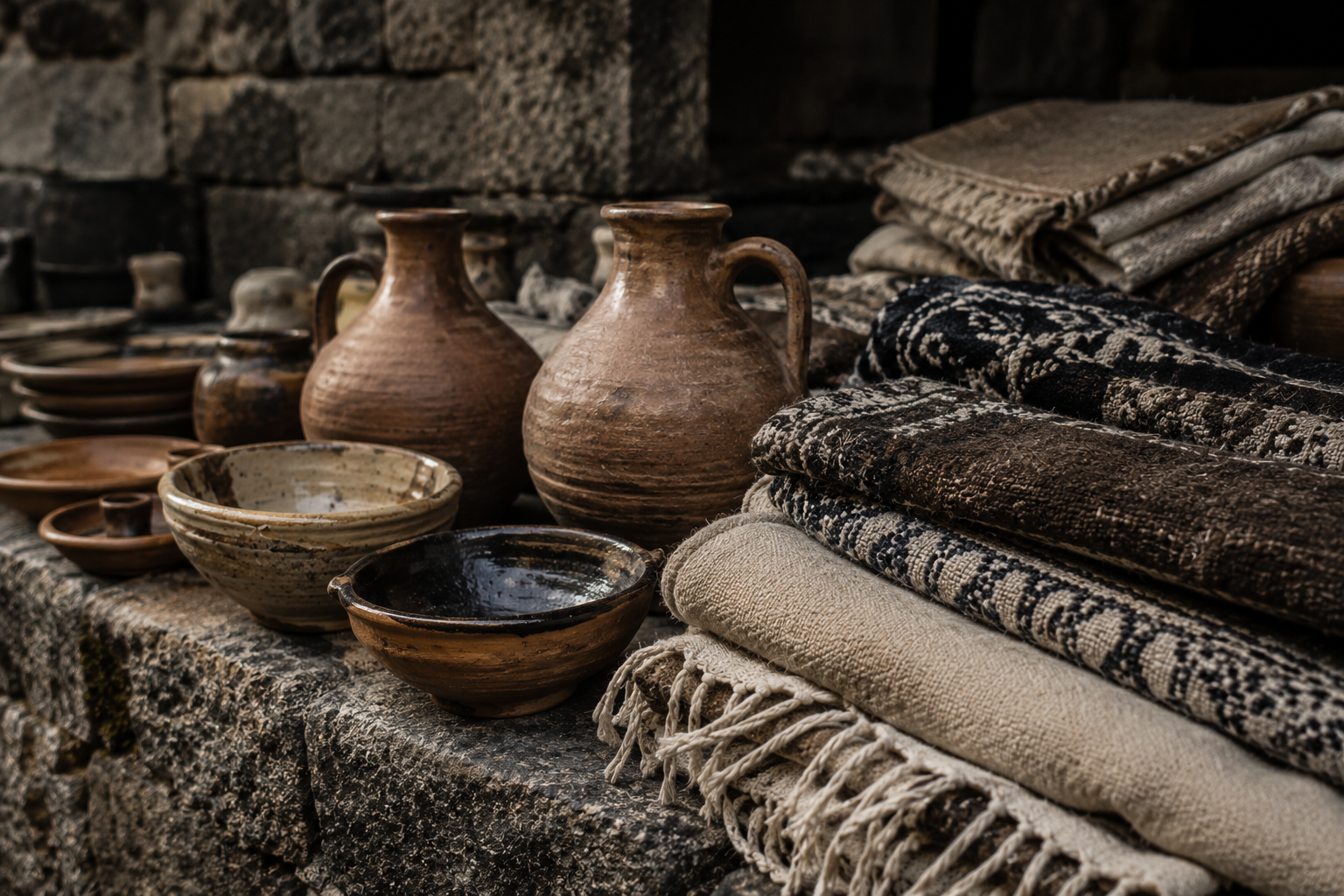
Bisalhães black pottery. Made without a wheel. Fired in an open pit. No glaze.
Bisalhães black pottery — olaria negra de Bisalhães — is produced in the village of Bisalhães near Vila Real, in the Trás-os-Montes region north of Serra da Estrela. It was granted UNESCO Intangible Cultural Heritage status in 2016. The pottery is made without a wheel, using hand-building techniques that predate the use of the wheel in European ceramics. It is fired in an open pit with smouldering pine wood, which produces the black surface through carbon absorption. No glaze is applied. The surface is burnished by hand before firing.
The result is a pottery that looks unlike anything produced by industrial or semi-industrial means. The forms are functional — bowls, jugs, cooking pots — but the surface has a quality that no factory process can replicate. Bisalhães pottery is found in craft shops throughout the north of Portugal and increasingly online. The village itself has a small number of active producers who welcome visitors.
In the world of ASHWANA, the Material Culture Division records what was made. Not how.
The Material Culture Division of Fort Kael maintains records of every significant material produced or traded within the mountain territory. Burel capes, blankets, honey, woven linen, pottery — all of these appear in the allocation records and trade ledgers of the Archive. The quantities. The seasons. The routes by which goods reached the fortress from the lower settlements.
What the records do not contain is the knowledge behind the goods. The process of making burel. The family in whose hands the linen patterns were preserved. The beekeeper who knew which plateau flowers produced the richest honey in which year. This knowledge was held by the people who did the work. It was never asked for. The Archive received the product. The knowledge stayed where it was — in the hands and the memory of the people who made things, in the villages that the Survey Division mapped but never fully understood.
ASHWANA — Book One of The Fractured Elden — is available now on Amazon, Apple Books, Kobo, and Google Play. The archive is not yet closed.