Three legends that have no clean ending.
The Serra da Estrela carries more than one story. The shepherd and the star is the most repeated, but it is not the oldest. Underneath it, and around it, are older accounts — accounts that predate the Christian naming of mountains and lakes, and possibly predate the Roman roads that first brought outsiders through the region in any number.
The Mouras Encantadas are among the most widespread figures in Portuguese and Galician folklore. They appear near ancient stone structures — dolmens, standing stones, granite outcrops — and are described as beautiful women under a spell, sometimes combing golden hair, sometimes singing. They guard something, though the accounts rarely agree on what. In the nineteenth century, scholars used reports of Moura sightings as a practical method for locating prehistoric monuments, on the logic that the stories clustered where the stones were. The connection between the folklore and the archaeology was consistent enough to be used as a survey tool.
The Lagoa Escura — the Dark Lagoon — is a lake in the Serra da Estrela said to have no bottom. Accounts attached to it describe underwater monsters, enchanted Moorish princesses waiting beneath the surface for a reconquest that never came, and the remains of ships from the Seven Seas drifting somewhere in its depths. The lake is in the middle of a mountain range far from the ocean. The ship stories have never been explained.
The black stork — the cegonha preta — appears in the region rarely and unexpectedly. Its arrival has been treated, across different periods of recorded history, as a signal of something coming. What it signals has never been agreed upon. The bird itself is real. The significance attached to its appearance belongs to a system of interpretation that no written source has fully preserved.
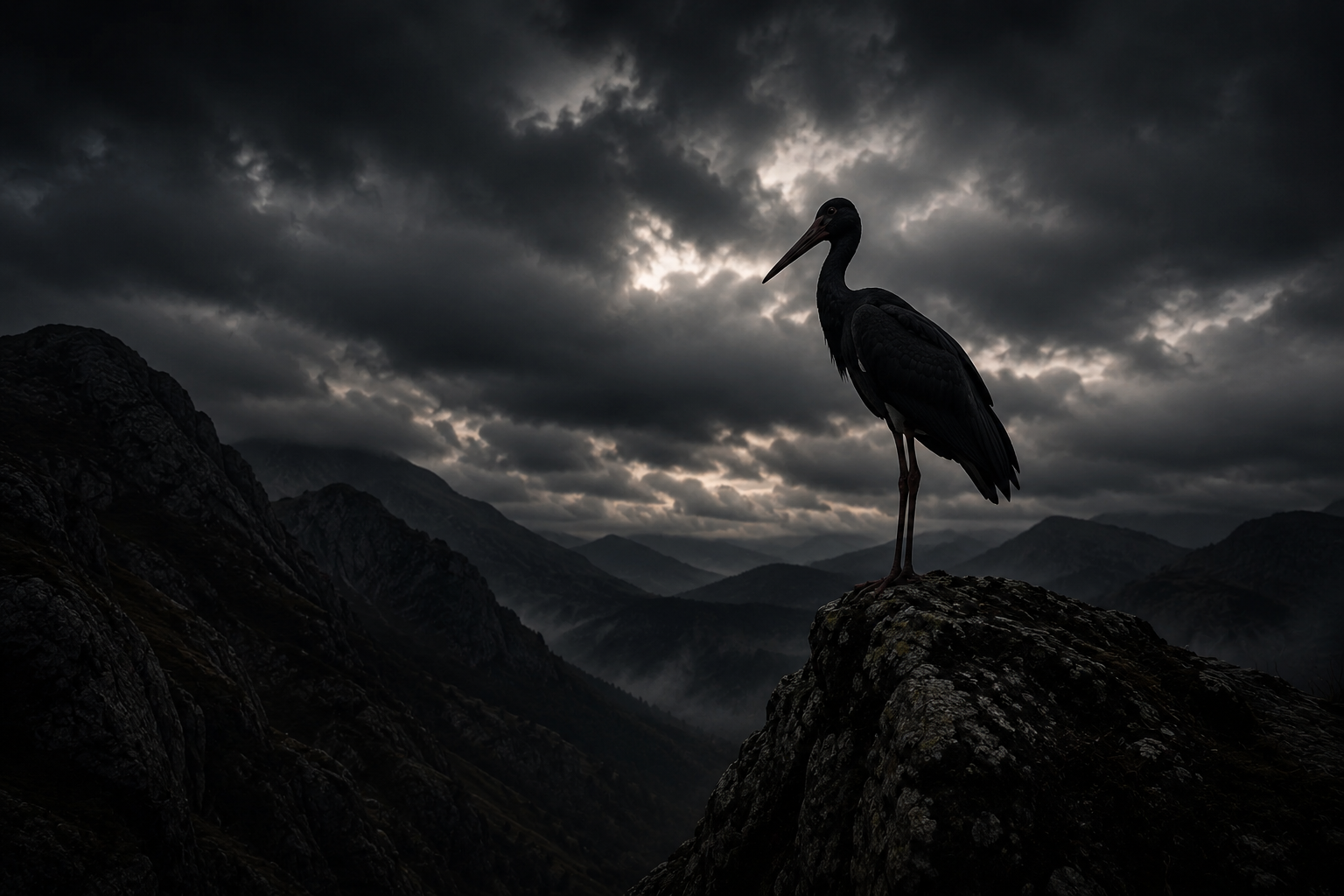
The stories survived. The framework that explained them did not.
ASHWANA's mythology works the same way. Fragments of a larger system appear in songs, rituals, place names, and damaged documents. No single character in the series holds a complete version of what the fragments add up to. The Mouras Encantadas are a real-world example of exactly this: a figure that appears consistently across centuries of folk memory, attached to real physical locations, without any surviving document that explains what the figure originally meant or where the belief came from.
The archive at Fort Kael holds a category of records filed under "atmospheric testimonies" — accounts submitted by survey teams describing things seen or heard in the field that did not fit any other classification. Several of these describe a figure near standing stones. The descriptions do not agree on details. They agree that something was present, that it was not accounted for in the survey brief, and that it was not investigated further.
One entry closes with a line that appears to have been added after the original filing: "The stones were already there when we arrived. Whatever was beside them was not in our remit."