The oldest Portuguese cheese. Made with a thistle, not an animal.
Queijo Serra da Estrela is the oldest cheese in Portugal, granted Protected Designation of Origin status by the European Union in 1996. It is made exclusively from raw milk of the Bordaleira Serra da Estrela and Churra Mondegueira sheep breeds — animals native to the mountain range, grazing on the spontaneous pastures of the high plateau. No other breed can be used. No other rennet can be used.
The rennet is the defining characteristic. Queijo Serra da Estrela is coagulated using an aqueous extract from the flowers of Cynara cardunculus — the cardoon thistle, a wild plant that grows across the Iberian Peninsula. The thistle extract gives the cheese a slightly bitter, complex flavour that animal rennet cannot replicate. This is not a choice made for preference. It is how the cheese has always been made. The thistle was available. Animal rennet, in the quantities required, was not.
The production season runs from November to March. This is when the Bordaleira sheep produce the richest milk — after the autumn rains have restored the pastures and before the summer heat arrives. Cheese made outside this window can carry the PDO name only if the milk is from animals that have maintained their seasonal cycle. The calendar is part of the product.
The milk is heated to 28 degrees. The thistle is added. The curd is broken by hand.
The production process has not fundamentally changed since the medieval period. Raw sheep milk is filtered through muslin cloth and heated to between 28 and 32 degrees Celsius. It is salted. Then the thistle extract is added — approximately 0.2 to 0.3 grams per litre, previously milled and mixed with salt and water. After 45 to 60 minutes, the curd is broken by hand. Not by machine. By hand, by someone who knows what the right texture feels like.
The broken curd is filtered again to remove the remaining serum, then moulded and pressed and salted again. The minimum maturation period for PDO classification is 30 days. The fresh version — queijo amanteigado, buttery cheese — is soft and spreadable at 30 days. The aged version — queijo velho, old cheese — matures for 120 days or more and develops a semi-hard to hard texture with a brownish-orange interior and a much more intense flavour.
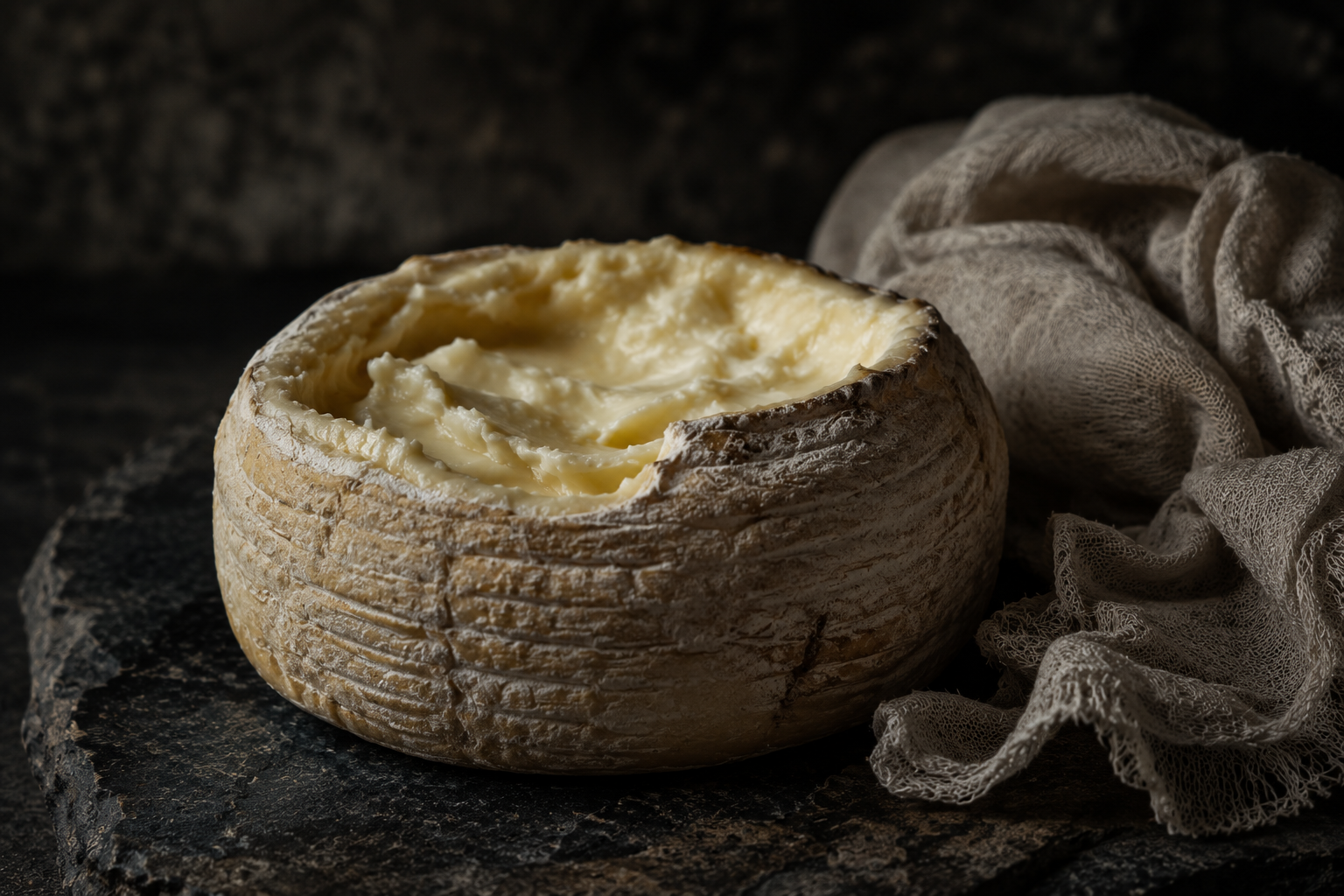
Cut a circle in the top. Remove the lid. Scoop with a spoon or spread on bread.
The fresh queijo amanteigado is not served in slices. The rind holds the soft interior together — at room temperature, the cheese inside has the consistency of thick custard or very soft butter. The traditional way to serve it: cut a circular lid from the top of the cheese, remove it, and scoop the interior with a spoon or spread it directly onto bread or toast.
The cheese should be served at room temperature. Cold from the refrigerator, it loses the softness that makes it what it is. Take it out at least an hour before serving. The flavour is intense — sheep's milk, slightly bitter from the thistle, with a richness that comes from the fat content of the Bordaleira breed. It pairs with bread that has enough structure to hold it, and with wine from the same region: the Dão appellation produces reds and whites that are made for this cheese.
The aged queijo velho can be sliced. It is a different cheese from the fresh version — harder, stronger, more bitter, closer to the Spanish manchego in texture though not in flavour. Both versions carry the PDO. Both are worth eating. The fresh version is what most people mean when they say Queijo Serra da Estrela.
Celorico da Beira. The market that Dom Dinis created in 1287.
The first cheese market for Queijo Serra da Estrela was established in Celorico da Beira in 1287 by King Dom Dinis. The market still exists. Celorico da Beira, in the Guarda district at the northeastern edge of the Serra da Estrela PDO region, holds a weekly market and a dedicated cheese fair in February and March — the end of the production season, when the new wheels are ready.
The cheese is also found in Manteigas, Seia, Gouveia, and Covilhã — the main towns of the Serra da Estrela region — in local shops and at producers who sell directly. Supermarkets in Lisbon and Porto carry it. The quality varies. The best Queijo Serra da Estrela comes from producers in the PDO zone who are still making it by hand, with milk from their own flocks, during the production season. The label will say PDO and will identify the producer.
The Archive records cheese rations. It does not record how the cheese was made.
The Material Culture Division of Fort Kael maintains ration records for every food item in regular supply to the fortress. Queijo da Serra — identified in the archive by its regional classification rather than its common name — appears in the ration ledgers from the earliest records onward. Weight per allocation. Frequency of delivery. Seasonal adjustment notes for the months when production was lower. The records are precise.
What the Material Culture Division does not record is the production process — the thistle, the hand-breaking of the curd, the muslin filtration, the specific temperature at which the milk must be held. This knowledge was held by the producers in the lower settlements, who supplied the fortress and were not asked to explain what they were supplying. The Archive received the cheese. The process remained with the people who made it. It has always worked this way.
ASHWANA — Book One of The Fractured Elden — is available now on Amazon, Apple Books, Kobo, and Google Play. The archive is not yet closed.